
Results
-
 £69.50
End of The Year Special - Andrew Pearce
The end of the year special is an original composition not based on any carols, written originally for orchestra for a French TV channel to celebrate their end of the year festivities. It's a short 2 1/2 minute opener with lots of tuned percussion and sleigh bells, plus some solo work for the euphonium. It's fun and festive and a great way to open any Holiday concert. There's even an optional part for women's chorus if you like. End of the Year Special could very well be the perfect opening for your Christmas concert.
Estimated dispatch 5-14 working days
-
 £115.60
Occurence - Haakon Esplo
Occurrence was written as a commissioned work for Randesund School Band in 2014. The symphonic work gives challenges for all instruments and is well suited to work with rhythm, intonation, sound and musicality. Percussion has a central rolein the piece with solo performances, and the beautiful middle part gives the band opportunity to demonstrate its ability to interpretation and musical understanding. Occurence is therefore well suited for competitions as well as concerts.
Estimated dispatch 5-14 working days
-
 £105.20
Bla vals - Idar Torskangerpoll
A piece that explore the "blue" notes in music, and where we have the constant change of 3 or 2 in a bar. Solo in Horn (cued in 1st Cornet). Make sure that the bass line and percussion is steady and firm throughout the piece.
Estimated dispatch 5-14 working days
-
 £152.99
Suite From Hymn of the Highlands - Philip Sparke
Complete score and full set of parts for Philip Sparke's Suite From Hymn To The Highlands for Brass Band. This work draws three expressive musical pictures of the Scottish highlands. The first movement, Ardross Castle, contains solo passages for horn and baritone and features a fascinating bagpipe melody. The second movement, Alladale, is a trio for tenor horn, flugel horn and baritone with an accompaniment featuring the percussion section. The final movement, Dundonnell,features two highly contrasting melodies, a wild presto and the bagpipe melody first heard in the first movement.
Estimated dispatch 5-14 working days
-
 £47.50
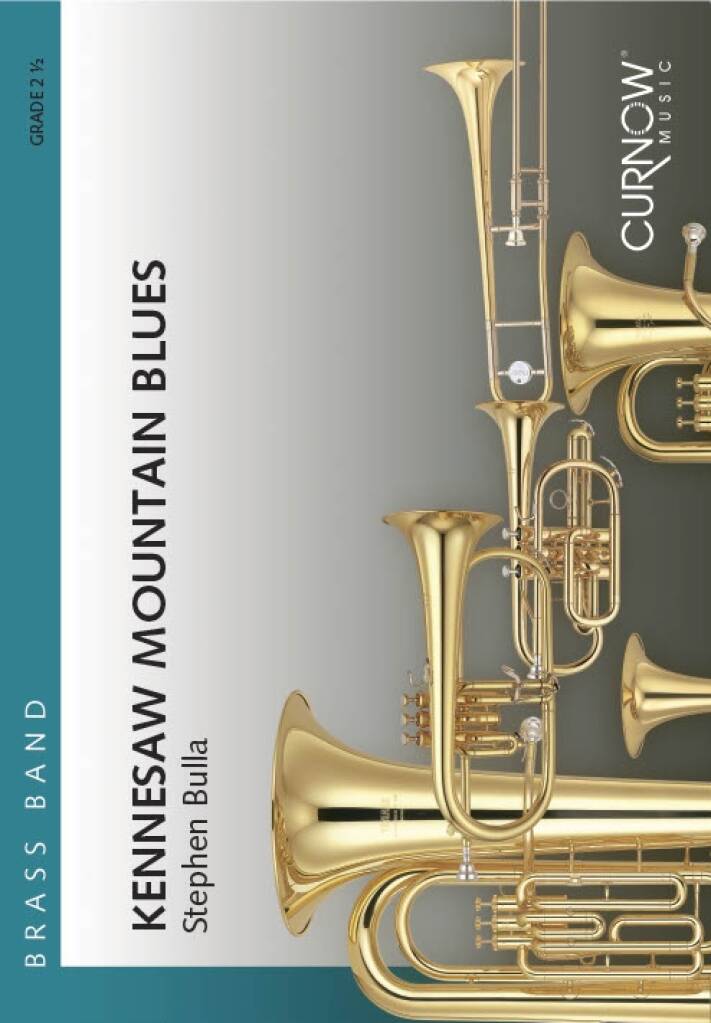
Kennesaw Mountain Blues - Stephen Bulla
Let your brass band play the blues. This inivotive work makes use of traditional blues harmonies over a strong rock beat. The cornets carry the melody first, but this is soon taken over by a solo percussion break. The piece also makes use of mixed time signiatures where the whole band plays the blues scale in an uneaven seven beats!
Estimated dispatch 5-14 working days
-
 £104.99
Cambridgeshire Impressions - Rieks van der Velde
In a four-part composition Rieks van der Velde takes us to the richly varied area surrounding the university city of Cambridge. The Dutch composer was especially inspired by the atmosphere of Cambridgeshire, the county which lies north ofLondon. 1. The Journey. Although on arrival the area looks peaceful and friendly, the ruggedness of its inhabitants and landscape have an unmistakable influence on the music. In the course of the tour, which starts with an Allegromovement, we are shown the vitality, energy and freshness of the Cambridgeshire countryside. Short themes, swift and sudden motifs and rhythmical patterns supported by the drive of percussion instruments give expression to this image. Thefirst part is concluded by two Calmo movements in which the music expresses how the cathedral in the city of Ely comes into sight and is gradually approached. 2. Visit to Ely Cathedral. The famous Norman cathedral church of Ely, whichwas built in 1109, has attracted tourists from all over the world apart from being a place of worship and heritage site. A cornet solo introduces the contemplative mood of the composition at this point. The mystical atmosphere of thecathedral runs through this lyrical part like a continuous thread. 3. The Pub. The thirst caused by this intensive journey makes a visit to the local pub a definite must. These "public houses", which may be open until the earlyhours of the morning, offer all kinds of entertainment. Drinks are served liberally and the atmosphere is lively. 4. The Journey Back. Time has flown: In other words, the moment of departure has come sooner than one would havewished. In a flashback which recaptures elements of the first part of the composition we say goodbye to Cambridgeshire in a fitting manner. Two scintillating final measures bring us abruptly back to the present.
Estimated dispatch 5-14 working days
-
 £74.99
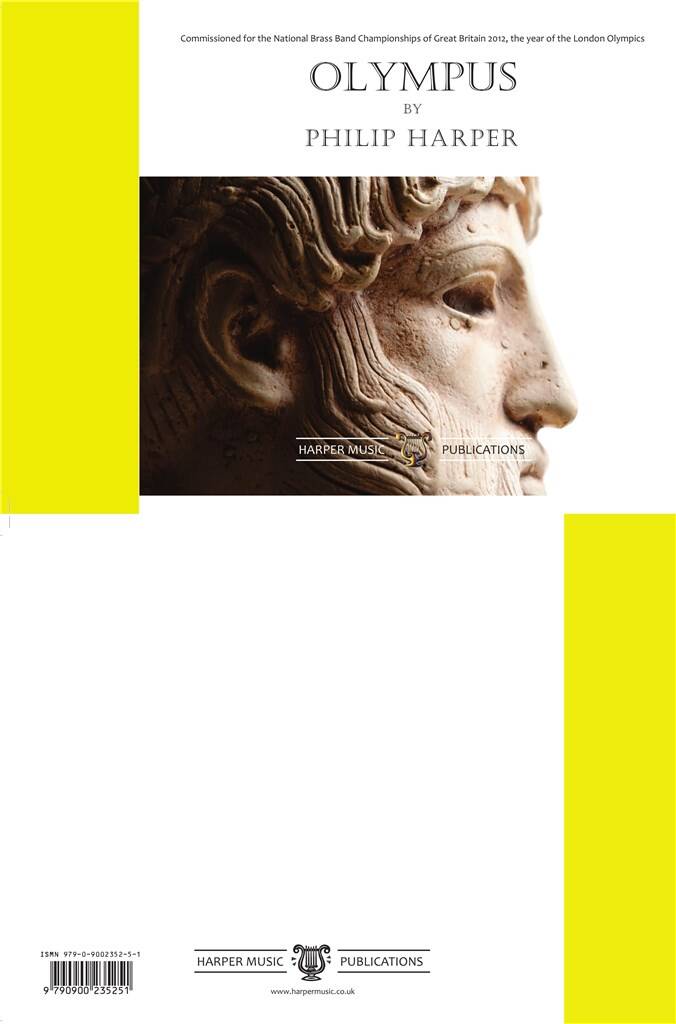
Olympus - Philip Harper
Selected as the test-piece for the 3rd Section Regional contests of the National Brass Band Championships 2012The music begins with a depiction of the exciting Opening Ceremony where noisy fanfares and sudden swells add to the cosmopolitan flag-waving clamour. Without a break the music leads to The Chariot Race, a fast compound-time gallop withthundering hooves in the basses and percussion, and a heroic melody introduced by the tenor horns. Chariot racing was the main equestrian event in the Ancient Greek Games, which were founded in memory of King Oenomaus. In the Greek legend he suffereddefeat in a chariot race to his son-in-law and Zeus' grandson, Pelops, but much of the music is bitter-sweet to symbolise the fact that Pelops had to cheat to win drawing parallels with some of the issues still facing modern-day athletics. A slow, mystical passage follows, describing The Temple of Zeus at Olympia. The statue of Zeus, who was honoured throughout the Ancient Games' history, was housed inside the temple and was one of the Seven Wonders of the Ancient World. Themusic depicts this period of the dawn of one of mankind's most ancient civilisations and there is a series of solo passages above a drone. The next section is called The Olympic Flame and a broad and lyrical anthem-like melody develops slowly in the euphoniums, which gradually ascends until the horns can take it over before passing upwards again to the cornets (Higher). The musicbursts into bright life at the lighting of the flame and the regular rhythmic pattern which has been established goes through an accelerando (Faster). The final section is called The Olympic Truce and aims to capture the cooperative spirit of the ancient practice of ending wars for the duration of the games. The anthem-like melody makes an affirmatory return (Stronger) and the work ends asit began with a blaze of colour and a real sense of optimism and global celebration. "Citius, Altius, Fortius" (Faster, Higher, Stonger)NOTES ON PERFORMANCEPercussion requirements: 1 to 3 players (3 Timpani, Snare Drum, Tenor Drum, Cymbals, Glockenspiel, Triangle)
Estimated dispatch 5-14 working days
-
 £15.00
Perseverance
DescriptionPerseverance was commissioned by Middleton Band to mark their 140th anniversary in 2016, supported using public funding by the National Lottery through Arts Council England, and featured on Middleton Band's CD of the same name.The title is taken from the original name of the 1876 band, the Middleton Perseverance Drum and Fife Band. According to the band's historical records, the Drum and Fife band was formed by six Middleton youngsters eager to learn music but short of funds. Following a whip round, they visited a music shop in Oldham where they purchased a 'one key flute' for six shillings and sixpence, and ('later on') a drum.This determination to make music despite the odds has been a characteristic of the band ever since; at the end of the second world war the band was again down to six players, who rebuilt the 'Middleton Borough Band' back to twenty-six players. After a period of some considerable success throughout the sixties and seventies culminating in winning the National Third Section title in 1983 the band hit hard times again in the late eighties and was down to only four members in 1987 before again being brought back to life. In recent decades the band has built a strong relationship with the East Lancashire Railway, another organisation which has battled sometimes mighty obstacles in its struggle to survive, and has maintained a thriving and successful youth band.The band's will to survive through adversity is reflected in the music, which builds from a sextet of four brass and two percussion players three times, only to fall back to the sextet twice. In the central slow movement the bass drum plays a 'heartbeat' rhythm as the remaining players remember those lost in the war. The relentless pace of the final section culminates in the band triumphing over the adversity which has curtailed the previous two sections. As a former member of Middleton Band (and one of the team that regained the National Third Section title in 2007) it is my pleasure to dedicate this work to the 'Pop and Ale Boys', Middleton Band.You can read more about the piece here.To view the accompanying video by Andy Marshall, designed to precede the piece, clickhereand find out more about the link between the video and the music here.Recording with Score VideoPerformance NotesIn performance the four brass members of the sextet (soprano, solo horn, solo trombone and solo euphonium) should stand at the sides of the band - soprano and horn behind the cornets, trombone and euphonium behind the trombones. Percussion may stand with them at the conductor's discretion, but only if the band has TWO snare drums and TWO concert bass drums available, as these are also needed at the back of the band in the tutti sections. In the second sextet snare drum should be muffled with a heavy cloth OR have the snares turned off (not both).Percussion and mutesPercussion required:snare drum (muffled with a heavy cloth at one point)concert bass drum, kit bass drum, hi-hat, suspended (crash) cymbal2 x tom-tomswood blockclash cymbals3 x timpanitam-tamglockenspielSoprano cornet, repiano and 2nd cornets, flugel and all trombones require metal straight mutes. Soprano, Solo Cornet 3/4, Repiano 2nd and 3rd cornets require cup mutes. Solo Cornet 1/2, Repiano, 2nd and 3rd cornets require harmon mutes.
Estimated dispatch 7-14 working days
-
 £39.95
Softly, As I Leave You - Alfred de Vita arr. Alan Catherall
Made popular by many singers over the years, this lovely song was first arranged for the Childs brothers as a solo, and later a duet, by Alan Catherall. It was first performed in the duet version at the Royal Albert Hall, London, in October 1985, conducted by their late father, John Childs. Also available with piano Brass Band Set comprises: Detailed condensed conductor score Solo B-flat Euphonium B-flat Euphonium Duet (2) E-flat Soprano Cornet Solo B-flat Cornet (4) 2nd B-flat Cornet (2) 3rd B-flat Cornet (2) B-flat Flugelhorn* Solo E-flat Horn* 1st E-flat Horn* 2nd E-flat Horn 1st B-flat Baritone 2nd B-flat Baritone 1st B-flat Trombone 2nd B-flat Trombone Bass Trombone B-flat Euphonium (2) E-flat Bass (2) B-flat Bass (2) 1st Percussion 2nd Percussion 3rd Percussion (Drum Kit) * Alternative parts for use as solo or duet provided. There is no Repiano Cornet part.
Estimated dispatch 7-9 working days
-
 £54.95
Festiva Brazilia (Brass Band - Score and Parts)
Using a variety of Latin American musical influences the piece opens with a bass riff that is to be the prominent feature in this work. Accompanied with lively Latin American Samba Percussion section the work is reminiscent of the music heard at the world famous Rio Carnival. There are lots of Latin 'Riffs' and 'Licks' throughout the piece that keep returning in true samba style. This is a real fun piece to perform and the performing notes below act as a guide to getting the most out of this performance.Performing Notes:There are opportunities for soloists within the piece, particularly Solo Cornet, Soprano and Bongo's.When the Cornet and Soprano soloist play their solo part they have an instruction to stand out at the front to perform. It is at the players and conductors discretion where they would like to stand for their solo line.Obviously the Drum Kit soloist is restricted to their current positioning within the band. However, the other percussionists are quite at liberty to come out to the front of the band to perform their solo at rehearsal figure P at the conductors discretion.NB - At the 5th bar of figure P there is an optional repeat section. Performers can repeat this section over and over to extend the percussion feature. Or even add more players from the band to play percussion. If you do not wish to use this opportunity then dismiss the repeat so that there is a 16 bar section between figure P and figure R.There are also a variety of cameo roles for other soloists and musical sections during the piece. Other players and sections can stand to perform various motifs during the piece again at the conductor's discretion.Festiva Brazilia was composed for performers to have fun and enjoy performing the piece as much as possible. Just like the many Samba festivals around Brazil.
Estimated dispatch 7-14 working days
 View Music