
Results
-
 £76.99
Invocation - Marc van Delft
In this work the Dutch composer Marc van Delft attempts to bring together two parties (former friends), after they have grown inexplicably apart. For this reason he calls in the help (Invocation) from the medium of music.At first, 'Invocation' radiates a sense of serene calme, from which the composer gradually creates an atmosphere resembling a conversation.Half-way there is an increase of suspense, ending once again in calm.The listener remains uncertain, however, regarding the finish. In dit werk probeert de Nederlandse componist Marc van Delft twee partijen samen te brengen (vroegere vrienden), nadat ze op onverklaarbare wijze uit elkaar zijn gegroeid. Daaromroept hij de hulp in (Invocation) van het medium muziek. In het begin straalt 'Invocation' een gevoel van serene rust uit, waaruit de componist geleidelijk een sfeer creeert die lijkt op een gesprek. Halverwege is er een toename van de spanning, die weer in rust eindigt. De luisteraar blijft echter onzeker over de afloop.
Estimated dispatch 5-14 working days
-
 £119.99
Amsterdam - Rob Goorhuis
Rob Goorhuis schreef de compositie Amsterdam voor Amsterdam Brass in 2002. Het werk beleefde haar premi?re in 2003 in een uitvoering van de opdrachtgever. De componist, zelf Amsterdammer van geboorte, heeft in dit werk zijn herinneringen aan de toen ook al bruisende stad muzikaal verwerkt in een combinatie met het heden. De geluiden van de stad zoals Goorhuis die in de 50-er jaren hoorde zijn al dan niet abstract weergegeven in Amsterdam. Amsterdam bestaat uit drie in elkaar overgaande delen. Het eerste deel (Allegro Moderato) beschrijft de grote drukte in de Nederlandse hoofdstad die altijd leeft, beweegt, zindert en schijnbaar nooit 'slaapt'. Devoortdurende zestiende beweging in de diverse instrumenten benadrukken die immer aanwezige drukte in de stad die in de volksmond bekend staat als 'Mokum'. Zelfs de klanken van een Amsterdams draaiorgel zijn goed hoorbaar in dit eerste gedeelte. De karavaan vuilnisauto's die elke ochtend om 5 uur door de straat van de nog jonge Rob Goorhuis reed is een hoorbare herinnering aan vervlogen tijden. Het tweede deel brengt ons in het Vondelpark aan de rand van het centrum. Het thema wordt voorgesteld door de bugel en voert via variaties op dit thema in diverse andere instrumenten naar een drukker gedeelte van het stadspark om vervolgens weer kort terug te keren naar de oase van rust.Het tempo en de begeleidende beweging zijn bepalend voor het bijzondere karakter van dit middendeel. Het derde deel zet ons weer met beide benen in het bruisende hart van de stad. De euphonium introduceert het grillige thema, met karakteristieke toonladderfiguren en kwartsprongen, dat in de verschillende stemmen canonisch wordt verwerkt. Halverwege duikt onopvallend het thema van het middendeel weer op dat steeds opvallender naar voren komt resulterend in een verrassend slot. Verplicht werk Nederlandse Brassband Kampioenschappen 2004 - 1e divisie.
Estimated dispatch 5-14 working days
-
 £127.30
I Byen Samarkand - Nordstoga - Svein H. Giske
Odd Nordstoga is an award winning Norwegian artist who has been active since the 1990's, working in the popular-/folk music genre. I have listened to a lot of Odd Nordstogas music, in particular the Heim te mor-album. When preparing for Askoy Brass Band's participation at Siddis Brass in 2008, I came across I byen Samarkand, another of Nordstogas tunes. This was from the Pilegrim album. I thought it had an exciting mix of expressions and included it in the band's repertoire for the Siddis Brass competiton. Pilegrim was initially a commision by the Bergen International Festival back in 2005, based on lyrics by author Ragnar Hovland and Odd Nordstoga's music. -Svein H. Giske -
Estimated dispatch 5-14 working days
-
 £60.99
Fanfare and Flourishes - James Curnow
What a way to open any concert. Fanfare and Flourishes is a spectacular short work that mixes all the pageantry of a military tattoo with the well-known Charpentier (1634-1705) Te Deum, a tune everyone will recognise as the theme tune for the Eurovision Song Contest! A brilliant piece to start a concert with a bang!
Estimated dispatch 5-14 working days
-
 £76.99
New Waves - Torstein Aagaard-Nilsen
New Waves is a special composition. Although contemporary but still attractive to musicians and listeners. Norwegian composer Aagaard-Nilsen has failed in a special way to add new elements to the contemporary wind music. Original exciting rhythms and contrasting harmonies make this composition enjoyable and challenging together. Interrupted by a slow middle section New Waves may be seen as five minutes jazz, rock and funk optima forma! New Waves is een bijzondere compositie. Weliswaar eigentijds maar toch aantrekkelijk voor muzikanten en luisteraars. De Noorse componist Aagaard-Nilsen is er op bijzondere wijze in geslaagd nieuwe elementen toe te voegen aan dehedendaagse blaasmuziek. Oorspronkelijke ritmes en spannende contrastrijke samenklanken maken het spelen van dit werk plezierig en uitdagend tegelijk. Onderbroken door een langzaam middendeel kan New Waves beschouwd worden als vijf minuten jazz, rock en funk optima forma!
Estimated dispatch 5-14 working days
-
 £69.99
Down by the Salley Gardens - Patrick Millstone
A thoroughly gripping melody of Irish descent constitutes the basis on which this exceedingly beautiful little piece of music rests. Down by the Salley Gardens is a guaranteed heartbreaker on your next concert. Since the lyrics of this Irish traditional are also supplied with the set, a combination of band with solo voice or even choir is a definite possibility. The Arranger: Leafing through a song-book containing traditionals etc., I was immediately struck by this song and its exceptionally beautiful and atmospheric melody. I simply had to do something with it. Een meeslepende traditional van Ierse komaf staat aan de basis van dit wonderschone werkje. Down bythe Salley Gardens belooft een hartenbreker te worden op uw eerstvolgende concert. De tekst van deze Ierse traditional wordt meegeleverd en daarmee is een combinatie met zang ook zeer goed mogelijk. De arrangeur: Bladerend door een liedboek met traditionals, enz., was ik meteen getroffen door dit nummer en zijn uitzonderlijk mooie en sfeervolle melodie. Ik moest gewoon iets mee doen.
Estimated dispatch 5-14 working days
-
 £76.99
Rhythm Forever - Andreas Ludwig Schulte
With this surprising little work, the composer not only intended to write a delightfully swinging composition. he also had an educational message up his sleeve. Especially as far as timing and rhytm are concerned there is plenty of action. Rhythm Forever might very well be an absolute showstopper on your next concert. Met dit verrassende werk, was het niet alleen de bedoeling van de componist om een heerlijk swingende compositie te schrijven, hij had ook een educatieve boodschap in petto. Vooral wat timing en ritme betreft is er volop actie. Rhythm Forever is een absolute 'showstopper' op uw volgende concert.
Estimated dispatch 5-14 working days
-
 £76.99
The Kingdom of God - Jerry B. Bensman
A brilliant concert-march in the best British martial tradition. Both the title and composition are based on the well-known hymn 'Seek Ye First the Kingdom of God'. Jerry B. Bensman schreef deze concertmars om zijn bands, die hij destijds dirigeerde, aan het werk te zetten. Met name de trombones en bassen moeten in deze mars (technisch gezien) aan de bak. Deze mars is dan ook een uitdaging voor de orkesten in de hogere divisies. Bensman maakt in deze mars gebruik van het lied 'Seek ye first the Kingdom of God' (Zoek eerst het Koninkrijk van God). De mars is daarom bij uitstek geschikt als muzikaal intermezzo in kerkdiensten en kerkconcerten.
Estimated dispatch 5-14 working days
-
£45.00
Finale to Act I of Tosca - Puccini, G - Harper, P
The spectacular Te Deum from the Finale to Act I of Tosca, it begins quietly with the tolling bell as worshippers gather for Mass. The euphonium plays the part of the villainous Scarpia as the music gathers strength. Finally the doors of the church are thrown open and the glorious Te Deum fills the hallowed space.Featured on the CD Cory in Concert Volume V.1st SectionDuration 5 minsListen to Cory BandCourtesy of World of Brass
In Stock: Estimated dispatch 1-3 working days
-
 £80.00
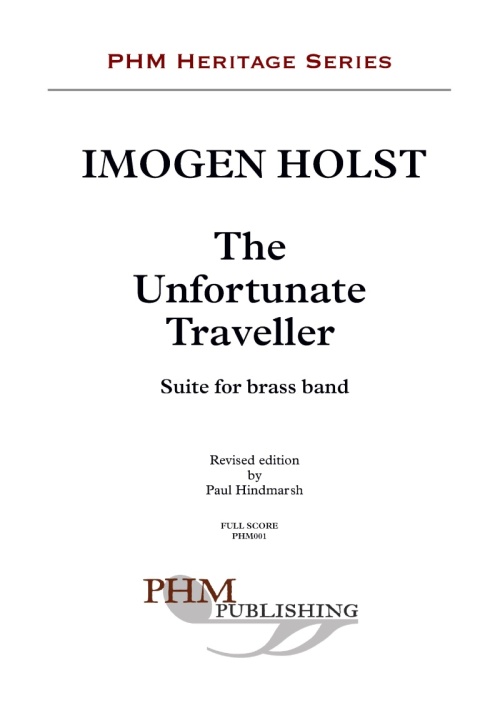
The Unfortunate Traveller (Brass Band - Score and Parts)
Imogen Holst (1907-1984) submitted The Unfortunate Traveller (1929) as her final work as a student portfolio at the Royal College of Music, where her composition teacher was Gordon Jacob. The title was taken from Thomas Nashe's famous 1594 picaresque novel of the same title. The Suite was first performed on 12 February 1933 at her Majesty's Theatre, Carlisle, by the St. Stephen's Band, with the composer conducting. Te concert was given in memory of Holst's uncle, Dr. H.A. Lediard. Holst had been impressed with the band's performance of his A Moorside Suite at the 1928 National Brass Band Championships (The Crystal Palace, South London) and was keen to work with them. Writing in Imogen Holst, a life in music, Christopher Grogan indicates that it was Gustav Holst's suggestion to include his daughter's work in the programme, quoting Imogen Holst's remarks made in interview to The Daily Mail as follows: "....it is the first time, so far as I know, that a woman has conducted a brass band at a public concert....It has been a delight to rehearse the St. Stephen's Band. It was their performance at the Crystal Palace Festival that inspired me to write this Suite, which I have dedicated to them."Imogen Holst accompanied her father to the Crystal Palace in 1928 to hear the performances of A Moorside Suite, and was so excited by the played and, audibly, by her father's music that she decided to write a brass band piece for her final examination. Te result was The Unfortunate Traveller (1929). However, it was not possible for her to present a brass band work for examination. She arranged it for string orchestra so that it could be played before she left the RCM in July 1930. Following the premiere of the original in 1933, the manuscripts did not resurface until 1969 Imogen found them among her late mother's effects. Although she requested score and parts be destroyed, they ended up in the possession of Manchester composer John Golland, who marked up the score presumably with the intention of creating a new performing edition. The original scoring reveals a lack of experience with what can be a tricky medium.With the agreement of the Holst Foundation, a revised edition, with additional percussion, was prepared in 2011 since when the work has been fortunate to travel round the world as a concert and contest piece. The original includes drums in the March only. The title was taken from Tomas Nashe's famous 1594 picaresque novel of the same title. Several Morris Dance tunes are introduced during the course of the four short movements, including Bonnie Green Garters, Shepherd's Hey, The Rose and The Wind Blaws Cauld. Quirky twists and turns of harmony and spirited rhythms that remind us how much Imogen Holst loved tradition English dance music.In September 2025, I made a performing edition of the composer's arrangement for string orchestra. The manuscript lacks the final movement, which I arranged in a similar style, ie. without extending the upper ranges. Making this edition raised some issues regarding the accuracy of my band version and some of the solutions I used to smooth out the voicing. I have used the composer's second thoughts to refine my performing edition and to correct a textual errors.- Paul HindmarshDuration: 10.00
Estimated dispatch 7-14 working days
 View Music