
Results
-
 £122.10
Den store dagen - Benny Borg - Bjørn Morten Kjærnes
This beautiful song contains a huge contrast between the hopeful and the disappointing. A mother has her birthday and is waiting her children to celebrate it. Each verse starts optimistically, but the short chorus is characterized by the disappointment, that everyone calls, and cannot come. This has been tried recreated musically, mostly in the last two choruses, as it dawns on her that she will not receive a visit. It's a beautiful tune, but with a serious message that it's easy to take someone for granted.One of the elements Hjorring Brass Band (DK) came up with after rehearsal, was that they really liked the change between the ballad parts with even eights and the swing parts. This also gives the piece a sense of "parlando" character, which tells a story, and is therefore important to focus. It is not quite simple, as the melody also in those parts with even eights has some triplet rhythms. Therefore, this is a topic you can work on very consciously.If you have heard the Wind Band version, you can notice that both keys and modulation are different in the Brass Band arrangement to sound better for this instrumentation.Regarding instrumentation, Flugelhorn, Solo Horn and Euphonium have important roles, in addition to Solo Cornet.It is also possible to use a vocal soloist, but then you have to soften the melody voices, especially, where small variations in the melody have been made for the wind instruments.
Estimated dispatch 5-14 working days
-
 £105.20
Irsk Fantasi - Roar Minde Fagerli
Irish fantasy is a short piece inspired by irish folk music. The melody consists of an A og B theme which both appears in many parts throughout the piece.The composer wrote this music originally for a kind of "musical journey around the world" project for beginning bands.
Estimated dispatch 5-14 working days
-
 £115.60
Battle of the Galaxy - Roar Minde Fagerli
Battle of the Galaxy is a suite in four movements. The composer describes the battle between the good and evil in a fantasy galaxy.The first movement is a journey into the galaxy. In the second movement dark and evil forces invade the galaxy. The third movement is the inhabitants hope for peace in the galaxy. In the last movement the heroes step forward and bring peace to the galaxy.The composer is inspired by films and TV series in the science fiction genre.
Estimated dispatch 5-14 working days
-
 £92.20
Go Far - Svein Fjermestad
The Title Go Far is a word play referring to what the players are going to (GO FAR!) and the musical inspiration from the TV-series Fargo (Mr. Wrench & Mr. Numbers). The piece is very groovy and especially the drum kit needs to lead the band and preferably sound like good, old John Bonham (drummer in the band Led Zeppelin). The melody is inspired by cool Native Americans and the band really needs to bring their primal roar! The piece was written for Eikanger-Bjorsvik Musikklag and their annual summer band camp Feriespel in 2017
Estimated dispatch 5-14 working days
-
 £115.60
Isolation - Suite in 5 Movements - Øystein Sjøvaag Heimdal
This suite in 5 movements was written during the Corona pandemic and is inspired by experiences and feelings during this period. Feelings like insecurity, frustration, happiness, sorrow, hope, and optimism are the underlying themes, and this can be heard through the music. This is not, however, program music, so the audience may have their own perception of what the music is about.This piece provides the opportunity to focus on the different elements of music, such as dynamics, articulation, expression, tone control and timbre.The five movements can be performed separately.
Estimated dispatch 5-14 working days
-
 £183.20
Pulsar - The Metamorphosis of a Star - John Brakstad
4th July in 1054 AD one of the most spectacular events was witnessed in the Cosmos. A massive star blew out; a supernova explosion.From the Earth it appeared as a new, bright star; the most brilliant in the sky. It was visible for three weeks, also in daylight, before it then faded away.But what was left of it is spectacular. Today we call it the "Crab Nebula".And in the very centre of the Nebula lies the remnant of the star; the core crushed by the force of gravity.This is a rotating neutron star, a pulsar, just 20 kilometres across, but so dense that it weighs more than our sun.As the neutron star spins, ejected particles stream out from its poles at almost the speed of light.These jets create powerful beams that sweep around as the star rotates.When the beams sweep across the Earth, they can be heard as regular pulses. We call them pulsars.In this piece there are three percussion parts. In addition there is an "optional part" to replace the marimba and vibraphone written in the three original percussion parts if desired. This fourth part is shown in the full score.
Estimated dispatch 5-14 working days
-
 £115.60
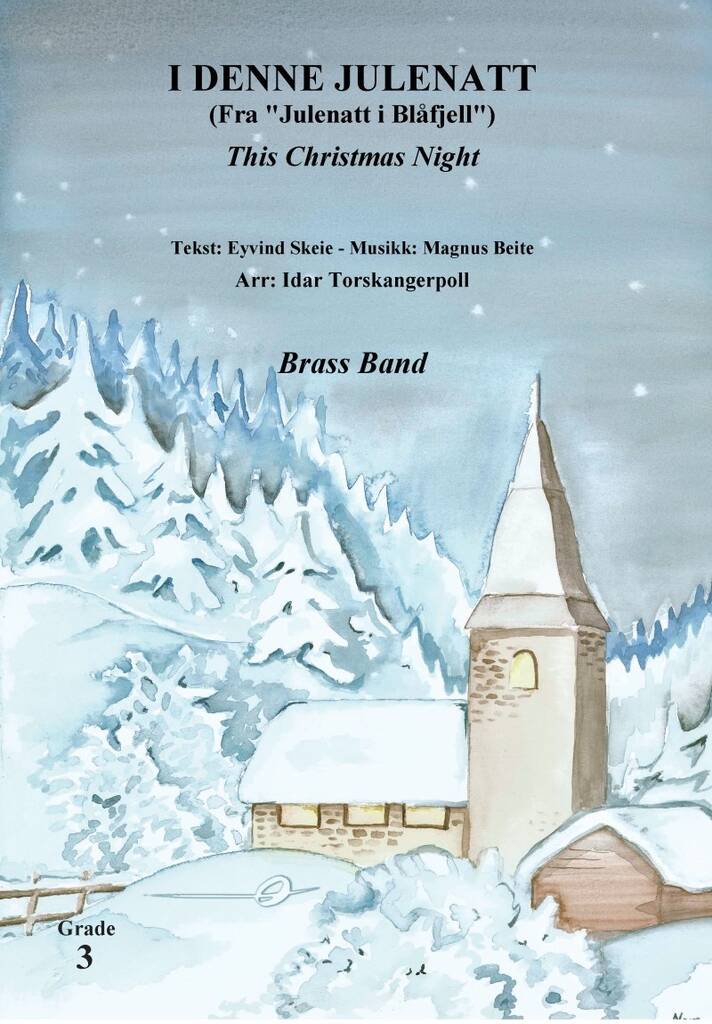
I Denne Julenatt (Fra "Julenatt i Blafjell") - Eyvind Skeie - Idar Torskangerpoll
"This Christmas Night" is taken from the Norwegian movie "Julenatt i Blafjell" who premiered in 2009. The movie is a follow-up to the very popular TV-series "Jul i Blafjell" og "Jul pa Manetoppen""This Christmas Night" was performed by Anita Skorgan, a famous singer in Norway.Make sure that all phrasing is done together and watch balance between instrument groups, thin out instrumentation if needed.
Estimated dispatch 5-14 working days
-
 £115.60
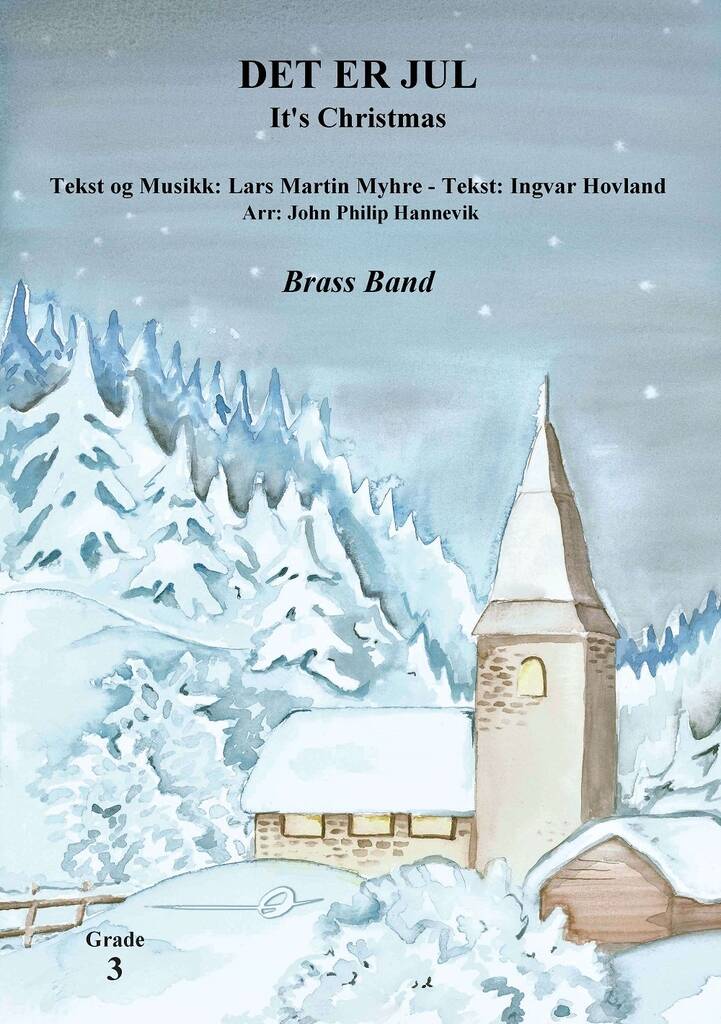
Det er jul - Lars Martin Myhre - John Philip Hannevik
This song was composed by the Norwegian singer-songwriter Lars Martin Myhre.The lyrics describe a person seeing the Holiday season approaching, with the feeling of being a bit on the side of society. Remembering the Childhood memories, the memories that are both warm but also bitter-sweet.The song was produced in cooperation with The Salvation Army in Norway in 2020.
Estimated dispatch 5-14 working days
-
 £105.20
Gressholmen - Kristian Kristensen - Reid Gilje
"Gressholmen" (in English "Grass-Islet") is a beautiful melody written by Norwegian singer/songwriter Kristian Kristensen.This arrangement is done in the same vocal character and style as the original recording. Please listen to this to find the best possible atmosphere and style.Best possible timbre and phrasing is two of the most important elements when performing this arrangement.
Estimated dispatch 5-14 working days
-
 £105.20
Daniels Joik - Jon-Henrik Fjâllgren - Idar Torskangerpoll
Jon Henrik Mario Fjallgren became instantly well-known after his appearance in Sweden's "Got Talent" where he performed "Daniels Joik" written for his recently passed best friend.Fjallgren was born in Cali, Columbia in 1987 but adopted by a Swedish Sami family and lives now as a reindeer herder, singer and composer. He debuted on stage in 2003, 14 years old and on record two years later.After the success with "Got Talent", he has also participated twice in the Swedish Eurovision Song Contest.This arrangement can be performed in a long or shorter version, for short version cut bars 58-78.
Estimated dispatch 5-14 working days
 View Music