
Results
-
 £105.20
Blaklokkevikua - Finn Ludt - Øystein Sjøvaag Heimdal
Blaklokkevikua is the most well-known song from the 1963 musical "Trost I taklampa". The music was written by Finn Ludt and the lyrics by Alf Proysen. This arrangement is quite simple and vary between full band and more limited instrumentation. Please be aware of the light swing-style throughout the piece and also use the indicated dynamics as close as possible.
Estimated dispatch 5-14 working days
-
 £105.20
Viss eg var ein julekonge (Fra Julekongen) - Stray - Øystein Sjøvaag Heimdal
This is the theme song from the Advent-series "Julekongen" ("The Chiristmas King"), premiered at the Norwegian Broadcasting Coprporation (NRK) in 2012. The present arrangement tries to recreate a bit of the mood from the original recording and performance of the song. You may let other players perform as soloist(s). The arrangement is suitable to focus on sound quality at all grade levels. You may end the performance at bar 61.
Estimated dispatch 5-14 working days
-
 £70.00
Smoke Sketches - Daniel Hall
Smoke Sketches is Daniel Hall's first original work to be published in the Faber Music Brass Band Series. Daniel is one of the most gifted of the rising generation of composers writing for brass bands. Smoke Sketches was composed at the invitation of Brass Bands England for the Intermediate Section of the 2017 National Youth Brass Band Championships of Great Britain. This colourful, jazzy suite draws inspiration from the ancient art of gazing into smoke from fire to find stories through the act of divination. Into the Blaze suggests someone briskly fire-walking, barefoot, with unexpected sparks fizzling from the ground. A Lonesome Ember capturesthe fleeting life of a small ember, beginning insignificantly and gradually evolving into a larger being before disappearing into ash, while Spark of Light bristles with life and energy. Band Grade 3/4, duration 8 minutes.
Estimated dispatch 5-14 working days
-
 £105.20
When We're Together - Kate Anderson - Haakon Esplo
Disney has done it again! This is music perfect for your band. The arrangement is written for young musicians keeping the challenges in leading part. The important musical elements of the piece are also doubled in several parts making the arrangement playable also with a limited instrumentation. The modulation towards the end differs a half tone from the original to make the arrangement playable for younger musicians.
Estimated dispatch 5-14 working days
-
 £118.99
Introduction and Variations on "Dies Irae" - Jan de Haan
After the introduction, in which the landscape of Groningen with its beautiful wide views is presented, follows five variations based on the 13th-century Gregorian theme Dies Irae that is attributed to Thomas van Celano. Each variation can be seen as a stage or a scene in the rich history of the village of Grijpskerk, making this work a very exciting and expressive piece of music for a contest or a concert.
Estimated dispatch 5-14 working days
-
 £60.99
Belvedere - Jan de Haan
Belvedere is a beautiful solo for Flugel Horn or Cornet and is partly taken from City Scapes, a concert work that was inspired by Central Park in New York City. The title Belvedere refers to 'Belvedere Castle', erected in 1869, and radiates the peaceful atmosphere of this place.
Estimated dispatch 5-14 working days
-
 £92.20
Lille Katt - Georg Riedel - Fredrick Schjelderup
This arrangement is based on the well-known melody "Little Cat" from the Swedish TV-series about Emil from Lonneberget written by Astrid Lindgren.The easy melody is arranged with a funky accompaniment and riffs, letting the beginners by soloists with the band.The arrangement also include song and rap where the young soloists, the band and the audience can be featured as soloists.
Estimated dispatch 5-14 working days
-
 £115.60
Dream of the Return - Pat Metheny - Ray Farr
Dream of the Return is one of the tracks on Pat Metheny's album of 1989 "Letter from Home".The CD recording is remarkable for its variety, imagination and musical artistry, and the combining of Latin American rhythms with jazz harmonyproduces magical results especially with Pat Metheny's guitar playing.While most tracks on the CD are instrumental, this song stands out because of its beautiful lyrics (by Pedro Aznar) which, roughly translated, are:I tossed a poemto the sea that took my questions and my voice.Like a sinking ship it was lost in the waves.I begged it not to return without having seen the open seaAnd in my dreams, show me what it had seen.Even if it did notcomeback I would know that it had journeyed.Floating all the time on calm or stormy seasEven though some safe haven waits.I waited long for its answer and almost gave up hope,And with a yearning voice I cried desperatelyto the heavens.Much later, somehow, it was washed ashore like an answered prayer.Now the rolling sea beats in my veins and sets my heart free
Estimated dispatch 5-14 working days
-
 £74.99
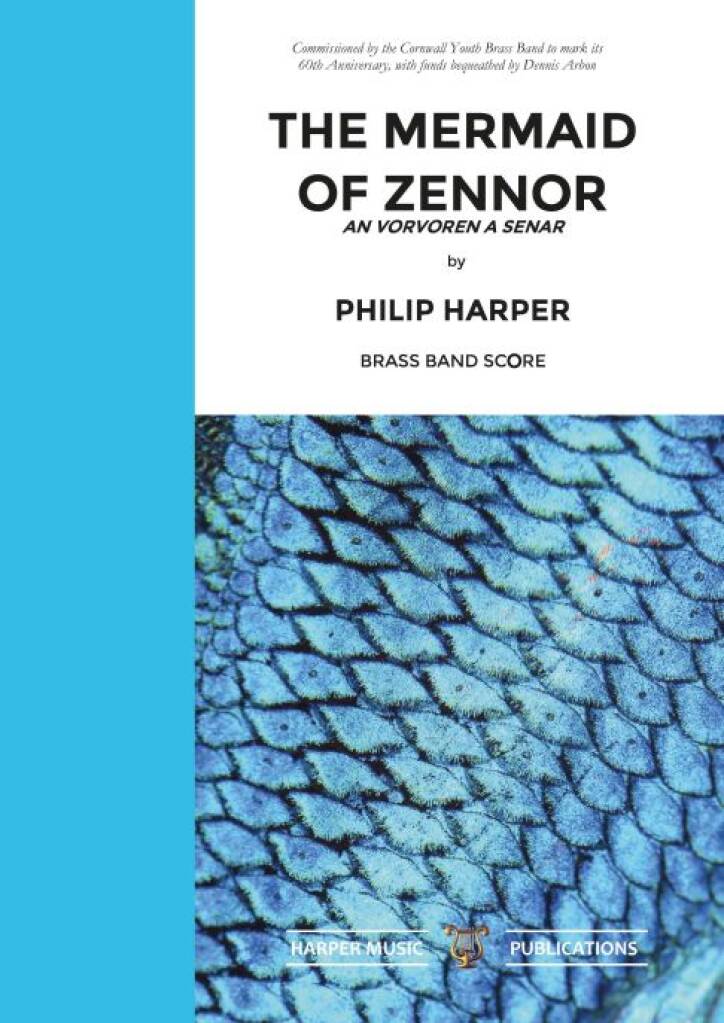
The Mermaid of Zennor - Philip Harper
Commissioned by the Cornwall Youth Brass Band to mark its 60th Anniversary, with funds bequethed by Dennis Arbon This piece is inspired by an old Cornish folk-tale set in the village of Zennor on the coast of Cornwall, the most South-Westerly countyof England.The music is in three sections:l. The Sea and Seafaringll. At the Churchill. Return to the Waves
Estimated dispatch 5-14 working days
-
£127.30
Beginner's Suite - Øystein Sjøvaag Heimdal
This is a four-part suite written for beginning bands at grade level 1. The four movements are different in character and style, and can be performed as a suite or as single movements.Every part is challenging and the melody are played by various instruments throughout the piece.Several doublings makes itplayable also with a smaller band than the scoring indicate.
Estimated dispatch 5-14 working days
 View Music