
Results
-
 £37.35
A Fugal Overture (Brass Band) Gustav Holst arr. Rob Bushnell
A Fugal Overture was written in 1922 by Gustav Holst. It was first performed at the Royal Opera House, Covent Garden on 14 May 1923 and was used as an opening work to Holst's one-act opera The Perfect Fool. It received its concert premiere on 11 October 1923 at one of Henry Wood's Queen's Hall Promenade Concerts. It is an early example of neoclassicism and was influenced by the counterpoint of J. S. Bach, despite its unconventional use of the fugal process. Holst began writing the piece in the summer of 1922, having hoped to develop it into a ballet. It is divided into three sections, the fugal subject with its distinct 3+3+2 pattern, a slower section with solos at the end, and a third section where the subject returns. Although reviews of the piece were mixed at the time of its premiere, the likes of Adrian Boult have said it was "an invigorating work that could effectively start any [...] concert". In more recent years, it has been compared to John Adam's A Short Ride in a Fast Machine. This arrangement is for the British-style brass band, with alternative parts for horns in F and bass-clef lower brass. A recording of the original composition can be found here: www.youtube.com/watch?v=a8xfwJyFq2E. Duration: Approx. 5.40 minutes Difficulty Level: 1st Section + PDF download includes parts and score. Sheet music available from www.brassband.co.uk Instrumentation: Soprano Cornet Eb Solo Cornet Bb Repiano Cornet Bb 2nd Cornet Bb 3rd Cornet Bb Flugel Horn Bb Solo Horn Eb 1st Horn Eb 2nd Horn Eb 1st Baritone Bb 2nd Baritone Bb 1st Trombone Bb 2nd Trombone Bb Bass Trombone Euphonium Bb Bass Eb Bass BbTimpani Percussion 1-2
In Stock: Estimated dispatch 1-3 working days
-
 £33.62
Adagietto from Symphony No.5 (Brass Band) Mahler arr. Keith M. Wilkinson
Gustav Mahler's Symphony No. 5 is arguably his best known and most loved composition. The Adagietto from that symphony, often performed on its own, is scored for strings and harp only and is widely regarded as one of the most beautiful tunes ever written. It is marked sehr langsam (very slow) and is immensely serene and tranquil, often performed at commemorative events such as the concert following the events of September 11th, 2001. It has been said that the movement is a love song to the composer's wife, Alma. The symphony was composed in 1901 and 1902 and this movement received its British premiere in 1909 at a Promenade concert directed by Henry Wood. The Adagietto received additional popularity when used in the 1971 film Death In Venice. This arrangement by Keith M. Wilkinson shortens the movement slightly and now gives brass bands the opportunity to programme this delightful work. To view a rolling score video of the work please visit https://www.youtube.com/watch?v=PxQRQy534lM Duration: Approx. 5.20 minutes Difficulty Level: 4th Section + PDF download includes parts and score. Sheet music available from www.brassband.co.uk (UK) or https://satradecentral.org (USA) Instrumentation: Soprano Cornet Eb Solo Cornet Bb Repiano Cornet Bb 2nd Cornet Bb 3rd Cornet Bb Flugel Horn Bb Solo Horn Eb 1st Horn Eb 2nd Horn Eb 1st Baritone Bb 2nd Baritone Bb 1st Trombone Bb 2nd Trombone Bb Bass Trombone Euphonium Bb Bass Eb Bass BbTimpani Percussion 1-2
In Stock: Estimated dispatch 1-3 working days
-
 £29.88
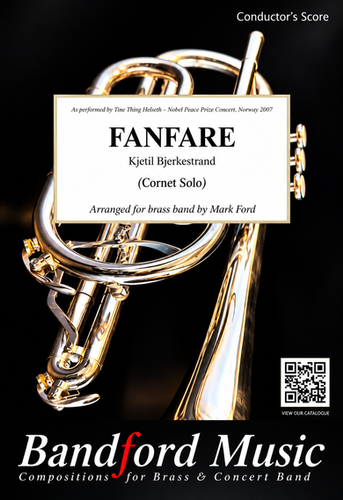
Fanfare (Cornet Solo with Brass Band) Kjetil Bjerkestrand arr. Mark Ford
Capture the prestige and grandeur of one of the world's most celebrated stages. Originally composed by Kjetil Bjerkestrand, this stirring fanfare opened the 2007 Nobel Peace Prize Concert at the Oslo Spektrum. The piece was famously premiered by the acclaimed Norwegian trumpeter Tine Thing Helseth, marking a historic moment broadcast to millions. This arrangement brings that same professional brilliance to the brass band concert stage, featuring a soaring solo cornet part that embodies the spirit of peace and international honor. To view a rolling score video of the work please visit www.youtube.com/watch?v=aMfjKLu8BjA Duration: 1.30 minutes Difficulty Level: 4th Section + This PDF download includes the full score and parts. Sheet music available at www.brassband.co.uk (UK) or https://satradecentral.org (USA) Instrumentation: Cornet Soloist Bb Soprano Cornet Eb Solo Cornet Bb Repiano Cornet Bb 2nd Cornet Bb 3rd Cornet Bb Flugel Horn Bb Solo Horn Eb 1st Horn Eb 2nd Horn Eb 1st Baritone Bb 2nd Baritone Bb 1st Trombone Bb 2nd Trombone Bb Bass Trombone Euphonium Bb Bass Eb Bass Bb Timpani Sus. Cymbal Marimba
In Stock: Estimated dispatch 1-3 working days
-
 £37.35
Horn Concerto No.1 1st Movement (Tenor Horn Solo with Band) Haydn arr. Wilson
Franz Joseph Haydn's Horn Concerto No.1 in D major was composed in 1762, when he was new to the Esterhazy court. It is a virtuosic concerto that showcases the beauty and range of the horn. The concerto was originally scored for solo horn and orchestra, and is one of Haydn's most popular works. Here it has been arranged by Duncan Wilson for tenor horn with brass band. His arrangement of the concerto is a faithful and effective adaptation of the original work. The movement opens with a lively tutti introduction, followed by the entrance of the solo horn. The horn plays a series of melodies and passages that are both lyrical and virtuosic. The band provides accompaniment and contrast, and the two interact in a lively dialogue. The movement builds to a climax and then concludes with a triumphant coda. To view a follow-the-score video please visit https://www.youtube.com/watch?v=Uo2K5tge6Fs PDF download includes score and parts. Sheet music available from: UK - www.brassband.co.uk USA - www.solidbrassmusic.com Difficulty Level: 2nd Section + Instrumentation: Tenor Horn Soloist Eb Soprano Cornet Eb Solo Cornet Bb Repiano Cornet Bb 2nd Cornet Bb 3rd Cornet Bb Flugel Horn Bb 1st Horn Eb 2nd Horn Eb 1st Baritone Bb 2nd Baritone Bb 1st Trombone Bb 2nd Trombone Bb Bass Trombone Euphonium Bb Bass Eb Bass Bb Timpani
In Stock: Estimated dispatch 1-3 working days
-
 £33.62
Men of Harlech (Brass Band) Welsh Traditional arr. Alex McGee
This contemporary take by Alex McGee on the Welsh folk song Men of Harlech will be an entertaining addition to concert programmes. The arranger writes: 'Men of Harlech is perhaps one of the most well known of all traditional Welsh folk songs, but not like this. This setting was inspired by a composer who I first encountered as a 14-year-old playing in his first regional brass band, Gareth Wood. Upon learning of the death of Gareth I felt compelled to honour his memory and his music in composition. I struck upon the idea to do what he had done to the tune Sosban Fach to Men of Harlech, to take the tune as the raw material and try to craft it into something new yet recognisable, modern yet accessible. The work attempts to highlight what for me are the underlying characteristics of we Welsh; prone to melancholy but quick to find joy, contradictory, inviting, welcoming and warm but capable of housing a fierce streak of nationalistic pride. I dedicate this work to Gareth Wood and thank him for his music.' To view a rolling score video of the work please visit: https://www.youtube.com/watch?v=YSoZnpnhEjQ Duration: 3.30 minutes Difficulty Level: 3rd Section + PDF download includes parts and score. Sheet music available from www.brassband.co.uk Instrumentation: Soprano Cornet Eb Solo Cornet Bb Repiano Cornet Bb 2nd Cornet Bb 3rd Cornet Bb Flugel Horn Bb Solo Horn Eb 1st Horn Eb 2nd Horn Eb 1st Baritone Bb 2nd Baritone Bb 1st Trombone Bb 2nd Trombone Bb Bass Trombone Euphonium Bb Bass Eb Bass BbTimpani Percussion 1-2
In Stock: Estimated dispatch 1-3 working days
-
 £59.99
Don't Stop Me Now - Christopher Bond
Although this tune by iconic band Queen met with a rather cool reception when it was first released in 1979, over the years it has become one of the bands most popular songs thanks in part to frequent use in advertising, television and film. Featuring trademark tight harmonies and a dramatic style shift from moderate ballad to double rock time, this arrangement will sound terrific even with young players. Note: whilst the demo video demonstrates the concert band arrangement, the version available to purchase on this website is the brass band transcription by Christopher Bond.
Estimated dispatch 10-14 working days
-
 £49.99
Journey To The Past - Christopher Bond
Step into an enchanting world of nostalgia with the compelling sounds of Journey To The Past, a wonderful little gem by Stephen Flaherty, magically arranged for brass band by Christopher Bond. This song, originally composed for the popular animated film Anastasia, tells a story of hope, discovery and finding one's true self. The warm brass band sounds add a new dimension, infusing each note with emotion and passion.
Estimated dispatch 10-14 working days
-
 £34.95
Storyteller - Christopher Bond
2016 marked one hundred years since the birth of iconic children's author, Roald Dahl. Storyteller, inspired by the imagination of Roald Dahl, is an ideal opener, with fizzing rhythmic motifs, forward-momentum, and a feeling of excitement through to the close. As with Dahl's magical imagination, ideas are presented boldly and developed throughout the work, with solo contributions from euphonium and baritone, and optional standing moments for soloists and sections. The work was commissioned by and written for Brighouse & Rastrick Band as the opening item to its podium-placed 2016 Brass in Concert programme, premiered at The Sage, Gateshead, on 20th November 2016.
Estimated dispatch 10-14 working days
-
 £34.00
Meditation: It is Well With My Soul
ABOUT THIS PIECE: Cantatio are pleased to release this hymn meditation on the much-loved hymn by Adam D J Taylor. Commissioned by the world famous Wingates Band, this arrangement became a centrepiece of the band's online presence during the COVID pandemic. Story time... Horatio Spafford was a successful attorney and real estate investor who lost a fortune in the great Chicago fire of 1871. Around the same time, his beloved four-year-old son died of scarlet fever. Thinking a vacation would do his family some good, he sent his wife and four daughters on a ship to England, planning to join them after he finished some pressing business at home. However, while crossing the Atlantic Ocean, the ship was involved in a terrible collision and sunk. More than 200 people lost their lives, including all four of Horatio Spafford's precious daughters. His wife, Anna, survived the tragedy. Upon arriving in England, she sent a telegram to her husband that began: "Saved alone. What shall I do?" Horatio immediately set sail for England. At one point during his voyage, the captain of the ship, aware of the tragedy that had struck the Spafford family, summoned Horatio to tell him that they were now passing over the spot where the shipwreck had occurred. As Horatio thought about his daughters, words of comfort and hope filled his heart and mind. He wrote them down, and they have since become a well-beloved hymn: When peace like a river, attendeth my way, When sorrows like sea billows roll-- Whatever my lot, thou hast taught me to say It is well, it is well with my soul. ENSEMBLE: Standard British Brass Band WHEN YOU BUY THIS PRODUCT, YOU GET: High-quality printed score and parts LEVEL: 2 - 3 LISTEN: DURATION: c. 7-minutes, 30-seconds EXAMPLE SCORE: Click here LEVEL GUIDE: Level 1- Accessible to all Level 2 - c. UK third section and higher Level 3 - c. UK second section and higher Level 4 - c. UK first section and higher Level 5 - c. UK championship section level
Estimated dispatch 5-7 working days
-
 £50.00
Reunion and Finale from Gettysburg
Recommended for Championship - 2nd Section Bands Music by Randy Endelman from the epic TV documentary Gettysburg, telling the historic story of the Battle of Gettysburg which was one of the defining moments in deciding the outcome of the American Civil War. This arrangement for brass band is by Andrew Duncan. Includes score & parts