
Results
-
 £69.99
Rogier van Otterloo Medley - Rogier van Otterloo - Thijs van Otterloo
Before his untimely death in 1988, Dutch composer Rogier van Otterloo became well-known for the film music he wrote to various successful Dutch movies. In this medley, made by his youngest son, Thijs van Otterloo, the themes of Help, de dokter verzuipt! (Help, the Doctor Is Drowning!, 1974) and Soldaat van Oranje (Soldier of Orange, 1977) have been used, as well as Esther (from Soldier of Orange). A fantastic trip into the field of world cinema music.
Estimated dispatch 5-14 working days
-
 £69.99
The Green Hills of Tyrol - Philip Sparke
The Green Hills of Tyrol was commissioned by Jrena and Beat Knusel for their son, Swiss euphonium player Joel Knusel, to celebrate his 20th birthday in 2019. The request was for a piece suitable for use in a solo competition, possibly using a Scottish or Irish melody, and composer Philip Sparke suggested an 'old-fashioned' air varie might be a suitable idea. The piece follows the well-established formula of a theme followed by four variations. The history of the original melody is fascinating and, although it is now well-known as a bagpipe tune, its background is Austrian or Italian, rather than Scottish. The tune appears as a chorus of Swiss soldiers in Rossini's 1829 opera William Tell but was possibly an existing Tyrolean folk tune. In 1854, during the Crimean War, Pipe Major John MacLeod of the 93rd Highlanders heard a band of the Sardinian contingent playing selections from the opera in camp before the Siege of Sebastopol. He was struck by the melody and arranged it for his pipers, calling it The Green Hills of Tyrol, referring to Tell's visit to that corner of Austria in the opera. It has since become universally popular among pipe bands who usually refer to it as A Scottish Soldier, following the addition of new lyrics in a 1961 hit by Andy Stewart.
Estimated dispatch 5-14 working days
-
 £76.99
Suite from Miss Saigon - Claude-Michel Schönberg - André Waignein
The musical Miss Saigon was a massive hit in London, Broadway and throughout the world. Based on Puccini's opera, Madame Butterfly, this epic production centers on the romance between a strong-willed Vietnamese woman and an American soldier during the Vietnam War. The story tells of two young lovers torn apart by war yet still held together by a burning passion. This medley features three of the best songs from the musical and mixes desperate love with optimism and joy. Relive the hit show with this catchy medley.
Estimated dispatch 5-14 working days
-
 £54.99
Stop the Cavalry - Jona Lewie - Stefan Schwalgin
Stop the Cavalry is a song about a British soldier at the front line whowrites a fictional letter to "Mr Churchill", begging him to send the armyhome because he'd prefer to spend Christmas with his darling. Thisrelaxed anti war song with a generous touch of British humour willcertainly help your band make a successful start or end to any concert.
Estimated dispatch 5-14 working days
-
 £104.99
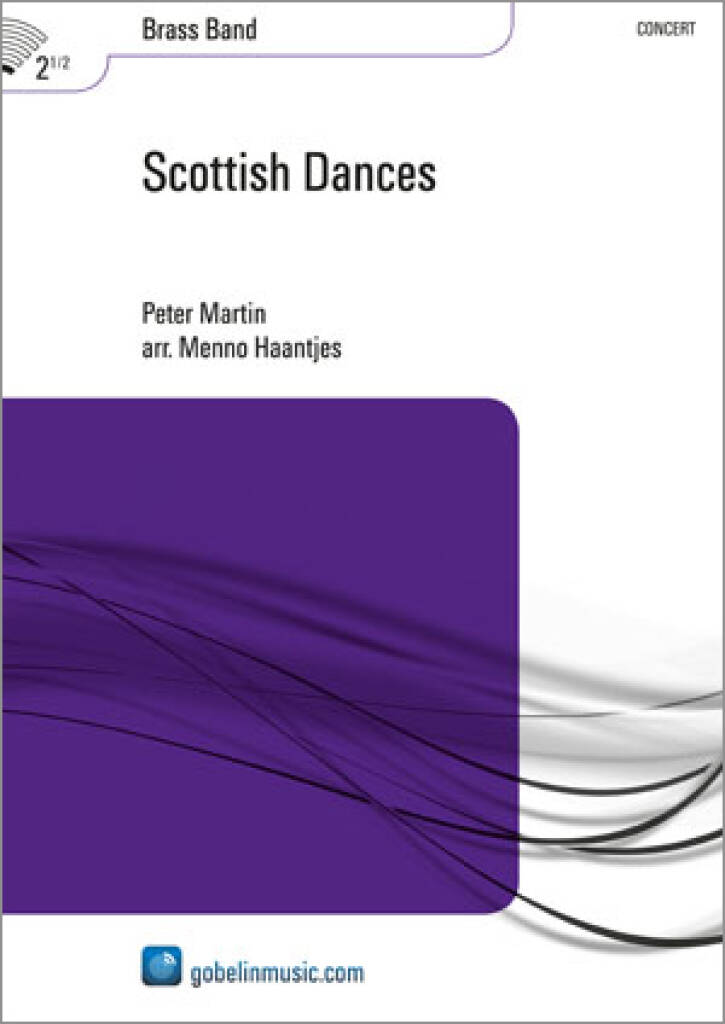
Scottish Dances - Peter Martin - Menno Haantjes
Scottish Dances is based on three Scottish traditionals: Cock of the North, The Bonnie Bank's O'Loch Lomond and Marie's Wedding. I. Cock of the North's name is used for multiple things or events. For example for a locomotive to a famous, it seems, delicious liqueur, and rallies to snowboard competitions. Furthermore is "Cock O' the North " a nickname of a famous Duke. (The 4th Duke of Gordon). In this composition Cock of the North (a Jig) is a traditional Scottish bagpipe tune, regularly played on tattoos by Pipe Bands. Not infrequently the drummers sing the text. Auntie Mary, had a canary, Up the leg of her trousers While she was sleeping Iwas peeping Up the leg of her trousers. II. " The Bonnie Bank's O'Loch Lomond " is about a sad story that took place during an revolt against the British. In 1745 Bonnie Prince Charlie had to retreat. Two of his men were captured. One was convicted and executed, while the other was released. The spirit of the executed soldier would arrive in Scotland via the 'low road' (underworld) before his companion, who had still a long way to go. You'll take the high road And I'll take the low road And I'll be in Scotland afore ye But me and my true love will never meet again On the Bonnie Bonnie Banks of Loch Lomond III. In a Scottish wedding, after the official ceremonies, there is often danced. This is called a ceilidh. For this we use traditional Scottish music such as "Marie's Wedding '. Mid dance we go back to the church, where a lovely song in honor of the couple sounds. Marie's Wedding has been recorded by Van Morrison (among many others). Step we gaely, on we go, heel for heel and toe for toe Arm and arm and on we go, all for Marie's wedding
Estimated dispatch 5-14 working days
-
 £67.24
Armistice at Flanders Fields (Brass Band) Dwayne Bloomfield
This poignant and powerful work for brass band by Dwayne Bloomfield describes the day peace was announced to end World War I. The piece was written in 2023 to be played by bands around the world to mark Armistice Day. The composer writes: 'Unless you were there, it's impossible to imagine what it must have been like the day peace was announced ending World War I. The feelings soldiers experienced, who after years of fighting and suffering, to know it was over and they would return home to see family and loved ones again. This piece tries to tell their story. The work begins by approaching the front, distant artillery and battle sounds heard while the carnage and loss of lives was already known to the world. The band builds as we enter the thick of battle, the death and destruction, the conditions faced and the loss of hope of ever surviving. The next section, in 7/8 time, reflects the two sides fighting - both sides attacking and defending with mostly little result, but for the loss of more lives. Two euphoniums then depict the news and hope of peace talks. However, fighting did continue right up to the very end and on the last day there would be another 2,738 casualties. The Canadians were still battling to capture the town of Mons that morning. A song is sung in reflection of the estimated 5.5 million allied soldiers who lost their lives during World War I, then a clock ticks down the final minutes. The last three known casualties are depicted with French soldier Augustin Trebuchon, killed at 10:45am by a single shot as he rushed down the trenches to spread the news of coming peace; Canadian George Lawrence Price killed by a sniper round at 10:58am at the battle of Mons, and lastly a machine gun burst that killed American Henry Gunther, who is believed to have fallen on the 11th hour. Bells then toll ringing around the world announcing the end of the war. After years of war, it must have been jubilation for the families at home knowing their loved ones would be returning to them. The band builds with a hymn for peace as a final tribute to those who fought, before the piece resides with one of the most dreaded sounds at that time, the knock on the door from a telegram delivery boy or better known then as the Angels of Death. It wasn't just the 2,738 families from the casualties of the last day who would receive such a knock, but many more who expected their loved ones to be returning home would instead find out they were instead killed in the last weeks. So close. Driving around the battlefields today one comes across many intersections in the countryside which have cemetery signposts pointing in every direction. While the last post sounds in ceremonies today, this last bugle call instead depicts the horrors, devastation and death the soldiers faced during the war and right up the 11th hour of the 11th day of the 11th month, Armistice at Flanders Fields.' To view a video of Dallas Brass Band performing the work please visit https://www.youtube.com/watch?v=ljfyVz3cMgk Duration: Approx. 15.00 minutes Difficulty Level: 2nd Section + PDF download includes parts and score. Sheet music available from www.brassband.co.uk Instrumentation: Soprano Cornet Eb Solo Cornet Bb Repiano Cornet Bb 2nd Cornet Bb 3rd Cornet Bb Flugel Horn Bb Solo Horn Eb 1st Horn Eb 2nd Horn Eb 1st Baritone Bb 2nd Baritone Bb 1st Trombone Bb 2nd Trombone Bb Bass Trombone Euphonium Bb Bass Eb Bass Bb Percussion 1-3
In Stock: Estimated dispatch 1-3 working days
-
 £48.56
Perspectives from Gallipoli (Brass Band) Fendall Hill
This powerful and evocative work by Australian-New Zealand composer Fendall Hill pays tribute to the ANZAC soldiers who passed through Weymouth, Dorset during World War I. Inspired by first-hand accounts, the piece follows the emotional journey of a young soldier - from eager enlistment, through the harrowing Gallipoli campaign, to recovery and reflection in Weymouth. Structured in four movements, the music captures anticipation, fear, fierce resistance, and eventual healing, culminating in a moment of remembrance. The hymn tune Wareham -written by Dorset composer William Knapp - features prominently as a thematic thread, honouring the region's historical connection to the ANZAC legacy. A deeply moving addition to the brass band repertoire, this work is both a musical narrative and a heartfelt gesture of gratitude to the people of Dorset for their care and ongoing commemoration of the ANZACs. To view a performance of the work featuring ANZAC Brass please visit www.youtube.com/watch?v=diz9TRz7rwE Duration: approx. 8.00 minutes Difficulty Level: 1st Section + PDF download includes parts and score. Sheet music available at www.brassband.co.uk (UK) or https://satradecentral.org (USA) Instrumentation: Soprano Cornet Eb Solo Cornet Bb Repiano Cornet Bb 2nd Cornet Bb 3rd Cornet Bb Flugel Horn Bb Solo Horn Eb 1st Horn Eb 2nd Horn Eb 1st Baritone Bb 2nd Baritone Bb 1st Trombone Bb 2nd Trombone Bb Bass Trombone Euphonium Bb Bass Eb Bass Bb Timpani Percussion 1-3
In Stock: Estimated dispatch 1-3 working days
-
 £39.95
Prelude on George Butterworth - Jonathan Bates
DURATION: 6 minutes. DIFFICULTY: 2nd+. Prelude on george Butterworth was composed as the prologue to the special Duhram Hymns event, alongside music by Orlando Gough and Jessica Curry, whilst using text by Carol Ann Duffy. The premiere performance took place in a packed Durham Cathedral, with the music for this pieces inspired by Durham Light Infantry soldier and renowned composer George Butterworth.
In Stock: Estimated dispatch 1-3 working days
-
 £30.00
La Musica Notturna Delle Strade di Madrid
DescriptionLuigi Boccherini was born in Lucca, Italy, into a musical family. His father, a cellist and double-bass player, sent him to study in Rome at a young age. In 1757 they both went to Vienna, where the court employed them as musicians in the Burgtheater. In 1761 Boccherini went to Madrid, entering the employ of Prince Luis Antonio of Spain, younger brother of King Charles III. There he flourished under royal patronage, until one day when the King expressed his disapproval at a passage in a new trio, and ordered Boccherini to change it. The composer, no doubt irritated with this intrusion into his art, doubled the passage instead, which led to his immediate dismissal. Then he accompanied Don Luis to Arenas de San Pedro, a little town in the Gredos mountains, where Boccherini wrote many of his most famous works. Although neglected after his death and throughout the 19th and early 20th century (he was known mockingly as 'Haydn's Wife' for a time), Boccherini's music has been rediscovered in recent decades.La Musica Notturna delle Strade di Madrid('Night Music of the Streets of Madrid') is a string quintet of seven short movements composed during Boccherini's exile in Arenas, no doubt to remind him and his prince of happier times. The music is reminiscent of "the gaiety and bustle of Spain's capital, recalling the sound of the city's church bells ringing for evening prayer, the popular dances that were the delight of its young people, and the blind beggars singing their typical songs". This arrangement excludes the first and last two movements, comprising the middle four:Il Tamburo di Soldati(The Soldier's Drum)Minuetto dei Ciechi(The Minuet of the Blind Beggars)Il Rosario(The Rosary)Passe Calle(The Passacaglia of the Street Singers)The music was featured in the Russell Crowe filmMaster and Commander: The Far Side of the World(2003) set during the Napoleonic Wars and featuring the adventures of the Royal Navy ship HMS Surprise and her captain Jack Aubrey as they pursue the French ship Acheron into the Pacific Ocean.You can listen to an audio preview while following the score in the video below!Duration approximately 5'00".
Estimated dispatch 7-14 working days
-
 £29.95
Battle Ground - Paul Sharman
This duet was written for Hendon Salvation Army band's annual Hendon Highlights concert, held at the Cadogan Hall in London. The soloists on that occasion were Philip Cobb and David Childs. A Salvation Army song entitled 'God's Soldier' provides the...
Estimated dispatch 5-7 working days
 View Music