
Results
-
 £82.95
The Flowers of the Forest (Brass Band - Score and Parts) - Bennett, Richard Rodney - Hindmarsh, Paul
In a preface to the score, the composer explains that 'the folk song The Flowers of the Forest is believed to date from 1513, the time if the battle of Flodden, in the course of which the archers of the Forest (a part of Scotland) were killed almost to a man'. Bennett had already used the same tune in his Six Scottish Folksongs (1972) for soprano, tenor and piano, and it is the arrangement he made then that forms the starting-point for the brass-band piece. A slow introduction (Poco Adagio) presents the folk song theme three times in succession - on solo cornet, on solo cornets and tenor horns, and on muted ripieno cornets in close harmony - after which the work unfolds through five sections and a coda. Although played without a break, each of these five sections has its own identity, developing elements of the tune somewhat in the manner of variations, but with each arising from and evolving into the next. The first of these sections (Con moto, tranquillo) is marked by an abrupt shift of tonality, and makes much of the slow rises and falls characteristic of the tune itself. The tempo gradually increases, to arrive at a scherzando section (Vivo) which includes the first appearance of the theme in its inverted form. A waltz-like trio is followed by a brief return of the scherzando, leading directly to a second, more extended, scherzo (con brio) based on a lilting figure no longer directly related to the theme. As this fades, a single side drum introduces an element of more overtly martial tension (Alla Marcia) and Bennett says that, from this point on, he was thinking of Debussy's tribute to the memory of an unknown soldier (in the second movement of En Blanc et noir, for two pianos). Bennett's march gradually gathers momentum, eventually culminating in a short-lived elegiac climax (Maestoso) before the music returns full-circle to the subdued melancholy of the opening. The work ends with a haunting pianissimo statement of the original tune.
Estimated dispatch 7-14 working days
-
£44.95
The Flowers of the Forest (Brass Band - Score only) - Bennett, Richard Rodney - Hindmarsh, Paul
In a preface to the score, the composer explains that 'the folk song The Flowers of the Forest is believed to date from 1513, the time if the battle of Flodden, in the course of which the archers of the Forest (a part of Scotland) were killed almost to a man'. Bennett had already used the same tune in his Six Scottish Folksongs (1972) for soprano, tenor and piano, and it is the arrangement he made then that forms the starting-point for the brass-band piece. A slow introduction (Poco Adagio) presents the folk song theme three times in succession - on solo cornet, on solo cornets and tenor horns, and on muted ripieno cornets in close harmony - after which the work unfolds through five sections and a coda. Although played without a break, each of these five sections has its own identity, developing elements of the tune somewhat in the manner of variations, but with each arising from and evolving into the next. The first of these sections (Con moto, tranquillo) is marked by an abrupt shift of tonality, and makes much of the slow rises and falls characteristic of the tune itself. The tempo gradually increases, to arrive at a scherzando section (Vivo) which includes the first appearance of the theme in its inverted form. A waltz-like trio is followed by a brief return of the scherzando, leading directly to a second, more extended, scherzo (con brio) based on a lilting figure no longer directly related to the theme. As this fades, a single side drum introduces an element of more overtly martial tension (Alla Marcia) and Bennett says that, from this point on, he was thinking of Debussy's tribute to the memory of an unknown soldier (in the second movement of En Blanc et noir, for two pianos). Bennett's march gradually gathers momentum, eventually culminating in a short-lived elegiac climax (Maestoso) before the music returns full-circle to the subdued melancholy of the opening. The work ends with a haunting pianissimo statement of the original tune.
Estimated dispatch 7-14 working days
-
 £69.99
Czardas (Xylophone Solo with Brass Band - Score and Parts) - Monti, Vittorio - Bomhof, Gert
Vittorio Monti was born on January 6, 1868 in Naples (Italy). His musical education (violin and composition), he enjoyed at the conservatory there. Around his 30's Monti went to Paris. He earned a living as a conductor and wrote several ballets and operettas. In his last years, Monti died in 1922, he devoted himself to teaching and composing. His famous "Czardas" has made his name known even today. Initially the czardas was a Hungarian folk dance , but after the mid-nineteenth century it was even a dance for the upper-class. Czardas begins with a slow introduction, the Lassan (slow and sad), and then the fast part, Friska, follows. Czardas is not, as so many people think typical gypsy music.Duration: 5.30
Estimated dispatch 7-14 working days
-
 £79.95
The Plantagenets (Brass Band - Score and Parts) - Gregson, Edward
A Symphonic Study for Brass BandThe Plantagenets was Gregson's first major test piece, written specially for the 1973 National Brass Band Championships.In this ambitious symphonic study he turned his attention to music which sets out to create a mood or atmosphere, in contrast to his earlier brass band works such as Essay and Partita where the underlying concerns are technical rather than expressive. However, Gregson is at pains to emphasise that The Plantagenets is not programme music. 'Symphonic' is the optimum word here. In its textural and harmonic complexity, its rhythmic and melodic variety, this was his most ambitious brass band piece so far. His language, with its roots in Hindemith and Bartok is further enriched here with the expressive language of Holst and Rachmaninov.As he says in his notes on the work: The Plantagenets attempts to portray the mood and feelings of an age - that of the House of Plantagenet which lasted from the middle of the twelfth century to the end of the fourteenth. To many it conjures up an age of chivalry and this is represented by fanfare motifs which occur throughout the work in varied form.Characteristically, the composer then goes on to describe not the atmosphere or mood he is trying to convey, but the means by which the music has been composed: the opening fanfares, based on the interval of the third, generating the musical material for the whole work; an exposition of two themes - one fanfare-like, one lyrical (on horns); a slow episode introducing a new melody on solo horn (answered by cornet and euphonium in canon); a little scherzo, fugal in character; and a recapitulation leading to a maestoso statement of the slow movement theme with a final reference to the fanfares as a triumphant conclusion.Duration: 11.30
Estimated dispatch 7-14 working days
-
£39.95
The Plantagenets (Brass Band - Score only) - Gregson, Edward
A Symphonic Study for Brass BandThe Plantagenets was Gregson's first major test piece, written specially for the 1973 National Brass Band Championships.In this ambitious symphonic study he turned his attention to music which sets out to create a mood or atmosphere, in contrast to his earlier brass band works such as Essay and Partita where the underlying concerns are technical rather than expressive. However, Gregson is at pains to emphasise that The Plantagenets is not programme music. 'Symphonic' is the optimum word here. In its textural and harmonic complexity, its rhythmic and melodic variety, this was his most ambitious brass band piece so far. His language, with its roots in Hindemith and Bartok is further enriched here with the expressive language of Holst and Rachmaninov.As he says in his notes on the work: The Plantagenets attempts to portray the mood and feelings of an age - that of the House of Plantagenet which lasted from the middle of the twelfth century to the end of the fourteenth. To many it conjures up an age of chivalry and this is represented by fanfare motifs which occur throughout the work in varied form.Characteristically, the composer then goes on to describe not the atmosphere or mood he is trying to convey, but the means by which the music has been composed: the opening fanfares, based on the interval of the third, generating the musical material for the whole work; an exposition of two themes - one fanfare-like, one lyrical (on horns); a slow episode introducing a new melody on solo horn (answered by cornet and euphonium in canon); a little scherzo, fugal in character; and a recapitulation leading to a maestoso statement of the slow movement theme with a final reference to the fanfares as a triumphant conclusion.Duration: 11.30
Estimated dispatch 7-14 working days
-
 £79.99
Seal of Unity (Brass Band - Score and Parts) - Deleruyelle, Thierry
Through a musical fresco, Seal of Unity tells the story of the Grtli Oath, an emblematic Swiss historical event dating back to the 13th century. The work begins in a mysterious fashion with the presentation of the main motif, representing the 3 primitive cantons. The piece then reveals all the colours of the brass band, with each of the instruments appearing in turn. After a slow chorale, the fast tempo returns before a dynamic and explosive coda.This work was commissioned by the Swiss Brass Band Association to celebrate the 50th anniversary of the Swiss Brass Band Championships, in 2025.Duration: 8.30
Estimated dispatch 7-14 working days
-
 £57.50
Erin's Isle (Euphonium Solo with Brass Band - Score and Parts) - Sparke, Philip
Erin's Isle was commissioned by euphonium player Micah Parsons and premiered by him in June 2024. The idea was to write a slow melody with an Irish flavour and the title is a romantic, 19th century name often used to refer to the island of Ireland itself. The work opens with fluttering, muted cornets, under which a tentative theme appears. This leads to an accompanied cadenza for the soloist, out of which the main theme emerges. This is a long and expansive melody, which winds through several related phrases with a folk-like flavour. A change of key heralds snatches of the theme by the band with interjections from the soloist, leading to a second cadenza. Eventually the band takes up the main theme again, over which the euphonium weaves an elaborate counter melody. The fluttering cornets return to allow the soloist to close the work with a brief and flowery coda.Duration: 7.45
Estimated dispatch 7-14 working days
-
 £94.99
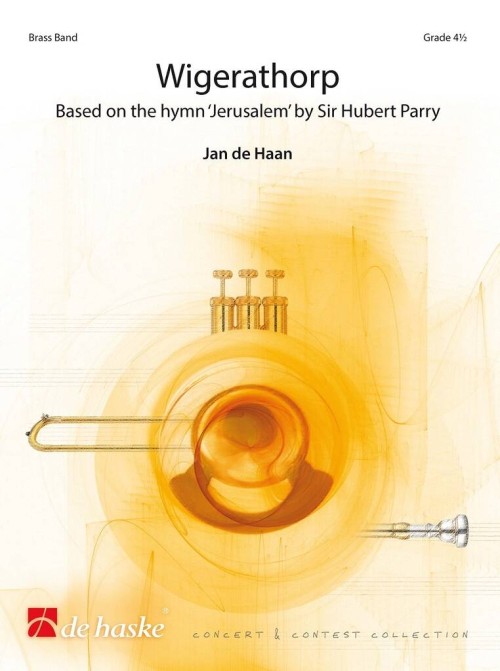
Wigerathorp (Brass Band - Score and Parts) - De Haan, Jan
Based on the hymn Jerusalem by Sir Hubert ParryBrass Band Gloria De, the group that commissioned this work, has its roots in the Frisian town of Gerkesklooster (the Netherlands), where the settlement Wigerathorp used to be. In the 13th century, a monastery was erected here, named Jeruzalem. This inspired the composer to base the work on the well-known melodious hymn Jerusalem by Sir Hubert Parry. Gercke's Overture - the monastery was built by order of landowner Gercke Harkema - is followed by a slow movement in which the founders of the monastery, The Monks of Claercamp, take shape through the Gregorian chant Veni creator spiritus. In the last movement, Monastery Jerusalem, the main theme develops in all its glory.Duration: 11.45
Estimated dispatch 7-14 working days
-
 £102.99
Sinfonietta No.1 (Brass Band - Score and Parts) - Jeanbourquin, Marc
Sinfonietta No.1 won first prize in the 2023 Composition Competition organized by the Swiss Brass Band Association. Various melodic themes and rhythmic motifs develop throughout the work. They combine with the numerous dynamic effects to bring a certain unity, from the beginning to the end of this competition piece. The technical and melodic difficulties allow the different soloists to show their virtuosity and musical prowess over five uninterrupted parts. After a first slow and misterioso part, there is a contrast with the following energico sequence based on an ostinato, creating both a progression and a tension, to drive everything towards the third part mesto (sad), then lento, where some cadenzas and numerous dissonances can be heard. The energico transition announces the fifth part, a ternary and fast con fuoco. This last part will lead the audience to a final apotheosis.Duration: 10.30
Estimated dispatch 7-14 working days
-
 £23.95
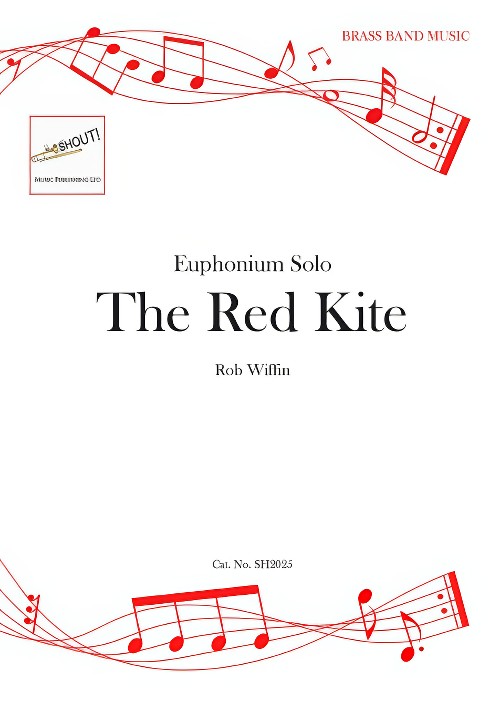
The Red Kite (Euphonium Solo with Brass Band - Score and Parts) - Wiffin, Rob
At one time the Red Kite was close to national extinction in the UK but now it is possible to admire this distinctive bird of prey with its red colouring and forked tail. I love watching it soaring so gracefully through the sky. I attempted to catch that feeling in this solo composed for Martin Smith. In writing it I had in mind making the euphonium glide solitary and effortlessly, occasionally swooping down then reclaiming its high altitude.To create the desired atmosphere, I avoided too many root position chords and enhanced the feeling of floating by adding notes to a lot of the harmony, giving it subtle colour. The harmonic rhythm is slow but the movement switches in the way that the Red Kite can make slight changes of direction by minor adjustments of its tail. On top of this accompaniment the soloist is left to sing with a sense of grace and freedom.- Rob WiffinDuration: 3.45
Estimated dispatch 7-14 working days
 View Music